
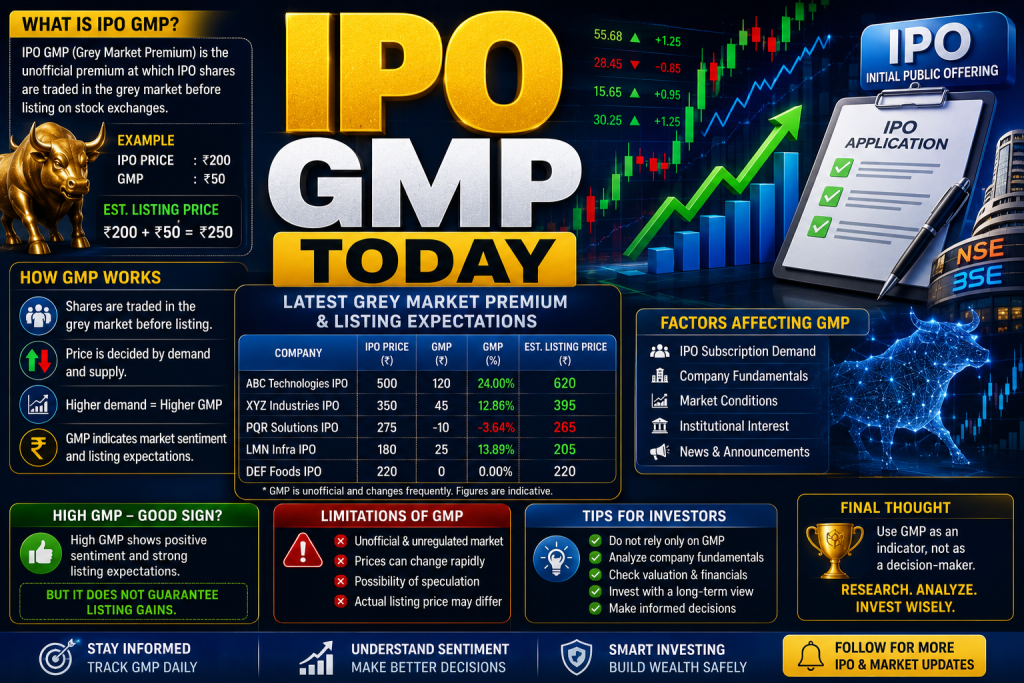
The Grey Market Premium (GMP) has become one of the most closely watched indicators whenever a new Initial Public Offering (IPO) enters the market. Investors often search for the latest IPO GMP to estimate the expected listing price and understand market sentiment before deciding whether to apply for an IPO.
While GMP can provide valuable insights into investor expectations, it is important to remember that it is an unofficial market indicator and should never be the only factor influencing an investment decision.
In this guide, we explain what IPO GMP is, how it works, why it changes every day, and how investors should interpret it.
What Is IPO GMP?
IPO GMP stands for Grey Market Premium.
It represents the amount investors are willing to pay above (or below) the IPO issue price in the unofficial grey market before the shares are listed on the stock exchange.
For example:
- IPO Issue Price: ₹200
- Grey Market Premium: ₹50
Estimated Listing Price:
₹200 + ₹50 = ₹250
This suggests that market participants expect the IPO to list around ₹250, although the actual listing price may differ.
What Is the Grey Market?
The grey market is an unofficial marketplace where IPO applications and shares are traded before the stock is officially listed on stock exchanges.
Unlike the NSE and BSE:
- It is not regulated.
- Trades occur privately.
- Prices are based on demand and supply.
- Transactions are conducted between willing buyers and sellers.
Because of its unofficial nature, GMP should be viewed as an indicator rather than a guarantee.
Why Does IPO GMP Change Daily?
Grey Market Premium changes continuously due to investor sentiment.
Major factors include:
Subscription Demand
Highly oversubscribed IPOs generally attract higher GMPs.
Company Fundamentals
Strong revenue growth, profitability, and business quality often increase investor confidence.
Market Conditions
Bullish markets usually support higher premiums, while weak markets can reduce them.
Institutional Interest
Strong participation from Qualified Institutional Buyers (QIBs) often boosts sentiment.
News and Announcements
Company developments, sector performance, or economic events may influence GMP movements.
How to Calculate Expected Listing Price
A simple formula is used:
Estimated Listing Price = IPO Issue Price + GMP
Example:
| IPO Price | GMP | Expected Listing |
|---|---|---|
| ₹150 | ₹30 | ₹180 |
| ₹300 | ₹120 | ₹420 |
| ₹500 | ₹0 | ₹500 |
| ₹250 | -₹20 | ₹230 |
A negative GMP suggests expectations of a listing below the issue price.
Does a High GMP Guarantee Listing Gains?
No.
A high GMP often indicates positive market sentiment, but it does not guarantee strong listing gains.
The final listing price depends on:
- Overall market conditions
- Investor demand on listing day
- Company valuation
- Institutional participation
- Global market sentiment
There have been many IPOs with high GMPs that listed below expectations, and others with modest GMPs that performed well after listing.
Advantages of Tracking IPO GMP
Monitoring GMP can help investors:
- Understand market sentiment.
- Compare different IPOs.
- Estimate potential listing prices.
- Gauge investor confidence.
- Follow changes in demand before listing.
Limitations of IPO GMP
Investors should also understand its drawbacks.
Unofficial Market
Grey market trading is not regulated by SEBI.
Prices Can Change Quickly
GMP may fluctuate significantly until the listing day.
Possibility of Speculation
Some movements are driven by speculation rather than fundamentals.
No Guarantee
Actual listing prices can differ substantially from grey market expectations.
Should Investors Apply Based Only on GMP?
The answer is no.
A good investment decision should also consider:
- Company financial performance
- Revenue growth
- Profitability
- Business model
- Industry outlook
- Valuation
- Risk factors
- IPO objectives
GMP should be treated as only one part of the overall analysis.
Tips Before Investing in an IPO
Before applying for any IPO:
- Read the Red Herring Prospectus (RHP).
- Review company financial statements.
- Compare valuations with listed peers.
- Check subscription data.
- Monitor GMP trends without relying solely on them.
- Consider your investment goals.
Why IPO GMP Is Popular
Many investors follow GMP because it provides a quick snapshot of current market sentiment.
Financial websites update GMP regularly, making it one of the most searched IPO-related metrics during the subscription period.
However, experienced investors typically combine GMP analysis with detailed research before investing.
Future of IPO Investing
India’s IPO market continues to expand as companies from technology, manufacturing, healthcare, financial services, and consumer sectors enter public markets.
With increasing investor participation, understanding concepts such as Grey Market Premium can help investors make more informed decisions, provided they also evaluate the underlying business fundamentals.
Conclusion
IPO GMP is a useful indicator that reflects unofficial market expectations before a company’s shares are listed. While it can provide valuable insights into investor sentiment and possible listing performance, it should never be treated as a guarantee of profits.
Successful IPO investing requires a balanced approach that combines GMP trends with company fundamentals, valuation analysis, financial performance, and broader market conditions. By using GMP as one of several research tools, investors can make more informed and disciplined investment decisions.