
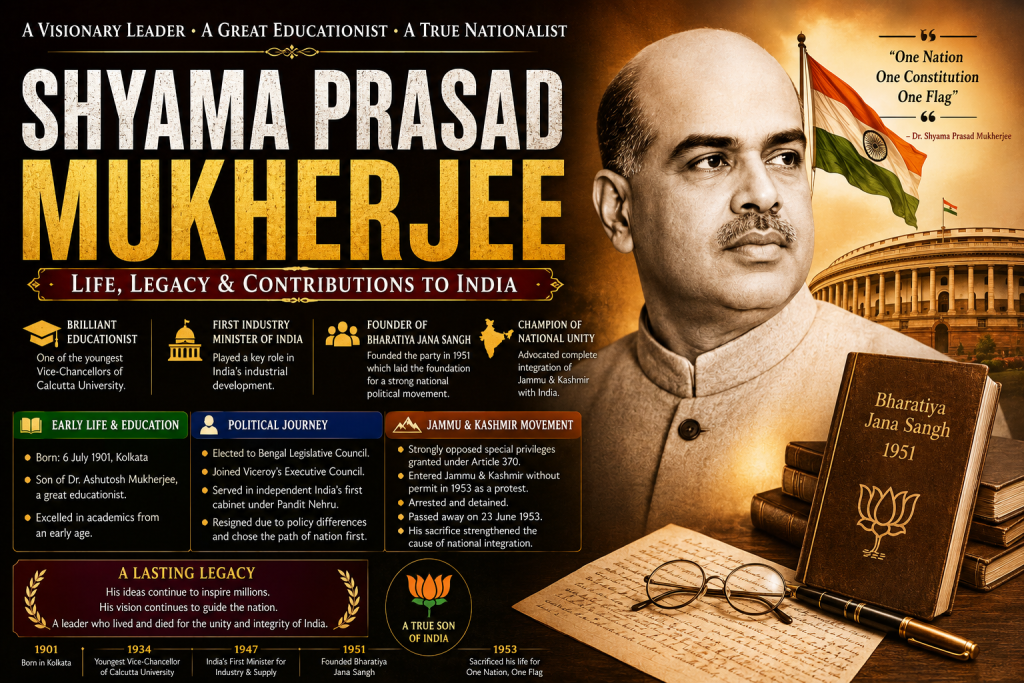
Shyama Prasad Mukherjee was one of the most influential political leaders and educationists in modern Indian history. Known for his strong nationalist views, commitment to national unity, and significant contributions to education and politics, Mukherjee played a crucial role during India’s formative years after independence.
His vision, leadership, and political philosophy continue to influence Indian politics even today. As the founder of the Bharatiya Jana Sangh, the ideological predecessor of the modern Bharatiya Janata Party (BJP), Mukherjee remains an important figure in India’s political landscape.
Early Life and Education
Shyama Prasad Mukherjee was born on 6 July 1901 in Kolkata.
He came from a distinguished academic family. His father, Ashutosh Mukherjee, was a renowned educationist and played a major role in the development of higher education in India.
Mukherjee excelled academically from an early age and completed his education with distinction. His achievements established him as one of the brightest intellectuals of his generation.
Youngest Vice-Chancellor of Calcutta University
One of Mukherjee’s most remarkable achievements came in the field of education.
At a relatively young age, he became the Vice-Chancellor of University of Calcutta, making him one of the youngest individuals to hold the position.
During his tenure, he focused on:
- Academic excellence
- Educational reforms
- Research development
- Expansion of higher education
His contributions significantly strengthened the university’s reputation.
Entry into Politics
Mukherjee entered politics during British rule and gradually became a prominent public figure.
He served in various legislative roles and became known for his:
- Strong leadership
- Nationalist ideology
- Administrative capabilities
- Commitment to public service
His political career expanded rapidly during the final years of British India.
Role During India’s Independence
Following India’s independence in 1947, Mukherjee joined the first cabinet of Prime Minister Jawaharlal Nehru.
He served as India’s first Minister for Industry and Supply.
In this role, he contributed to:
- Industrial development
- Economic planning
- Infrastructure initiatives
- Manufacturing growth
His efforts supported India’s early nation-building process.
Differences with the Government
Despite serving in the cabinet, Mukherjee later developed differences with government policies on several national issues.
These disagreements eventually led him to resign from the cabinet.
His resignation marked an important turning point in his political journey and helped shape his future role as an opposition leader.
Formation of Bharatiya Jana Sangh
In 1951, Mukherjee founded the Bharatiya Jana Sangh.
The party emphasized:
- National unity
- Cultural identity
- Strong governance
- Economic development
Over time, the Bharatiya Jana Sangh became an important political force in India and later evolved into the Bharatiya Janata Party (BJP).
Jammu and Kashmir Movement
One of the most significant chapters of Mukherjee’s political life involved his opposition to special arrangements related to Jammu and Kashmir.
He strongly advocated the principle:
“One Nation, One Constitution, One Flag.”
Mukherjee argued that complete integration of Jammu and Kashmir with India was essential for national unity.
His position on this issue remains one of the most discussed aspects of his political legacy.
Arrest and Death
In 1953, Mukherjee entered Jammu and Kashmir without a permit as part of a political protest.
He was arrested and detained.
While in custody, he fell ill and later passed away on 23 June 1953.
His death remains a significant and often debated event in Indian political history.
Many supporters viewed him as a leader who sacrificed his life for national integration.
Contributions Beyond Politics
Mukherjee’s legacy extends beyond political activities.
Education
He worked extensively to improve higher education and academic standards.
Industry
As Industry Minister, he supported industrial development during India’s early years of independence.
National Integration
His advocacy for national unity continues to influence political discussions.
Public Service
Mukherjee consistently emphasized public welfare and nation-building.
Why Shyama Prasad Mukherjee Remains Important
Several reasons explain why his legacy continues to be relevant.
Historical Influence
His ideas influenced political movements that continue shaping India today.
Educational Contributions
His role in strengthening higher education remains widely recognized.
National Unity
His views on integration and sovereignty remain important subjects of political discussion.
Political Legacy
Many contemporary political leaders continue to reference his vision and contributions.
Memorials and Recognition
Various institutions, roads, educational centers, and public projects across India have been named in his honor.
His birth anniversary and death anniversary are regularly commemorated by political leaders, educational institutions, and supporters.
These events highlight his enduring significance in Indian public life.
Historical Perspective
Historians view Mukherjee as:
- A prominent educationist
- A nationalist leader
- An influential parliamentarian
- A key opposition voice during India’s early democratic years
While opinions about some of his political positions may differ, his impact on Indian politics and public discourse remains undeniable.
Conclusion
Shyama Prasad Mukherjee occupies an important place in India’s political and educational history. From becoming one of the youngest Vice-Chancellors of Calcutta University to serving in independent India’s first cabinet and founding the Bharatiya Jana Sangh, his contributions were both significant and far-reaching.
His advocacy for national unity, educational reform, and public service continues to influence discussions about India’s development and governance. More than seven decades after his passing, Mukherjee remains a respected and influential figure whose legacy continues to shape modern India.