
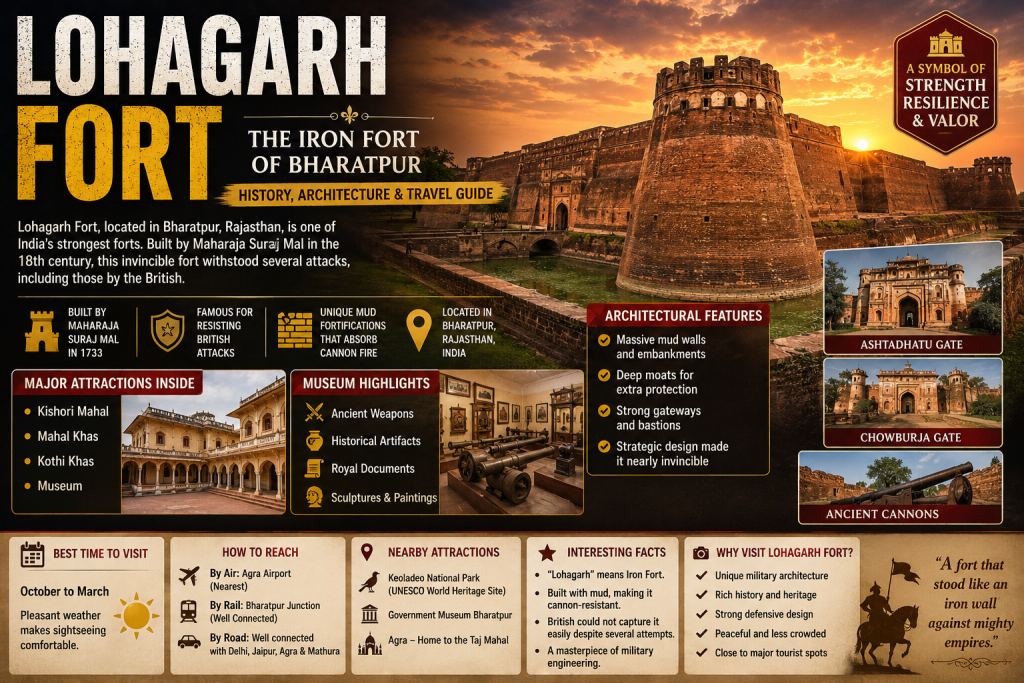
Lohagarh Fort is one of India’s most remarkable historical forts and a symbol of strength, resilience, and military engineering. Located in the city of Bharatpur, the fort is famous for its unique defensive design and its ability to withstand repeated attacks by powerful invading armies.
Unlike many forts known for lavish palaces and ornate decorations, Lohagarh Fort earned its reputation through its exceptional defensive capabilities. The name “Lohagarh” translates to “Iron Fort,” reflecting its reputation as an almost impregnable stronghold.
Today, the fort remains one of Rajasthan’s most important historical landmarks and attracts visitors interested in history, architecture, and cultural heritage.
History of Lohagarh Fort
Lohagarh Fort was built during the 18th century by Maharaja Suraj Mal, one of the most respected rulers of the Bharatpur Kingdom.
Construction began around 1733 and was completed several years later. Maharaja Suraj Mal designed the fort not merely as a royal residence but as a powerful military fortress capable of resisting enemy invasions.
The fort became famous because it successfully resisted attacks from several powerful forces, including the British East India Company.
Why Is Lohagarh Fort Famous?
Strong Defensive Design
Unlike traditional stone forts, Lohagarh Fort utilized:
- Massive mud embankments
- Thick defensive walls
- Deep moats
- Strategic gateways
These features absorbed the impact of cannon fire more effectively than conventional stone structures.
Resistance Against British Attacks
One of the fort’s most famous achievements occurred during the early 19th century when British forces attempted to capture it.
Despite multiple attacks and heavy artillery bombardment, the fort remained unconquered for an extended period, enhancing its reputation as an invincible fortress.
Architectural Features
Massive Fortifications
The fort’s defensive walls are among its most impressive features.
Rather than relying solely on stone, engineers used earth and mud reinforcements that absorbed shock from enemy cannons.
Deep Moats
The surrounding moat added an additional layer of protection against attackers.
Strategic Gateways
Important gates include:
- Ashtadhatu Gate
- Chowburja Gate
These gates hold historical and artistic significance.
Bastions and Watchtowers
The fort contains several defensive towers used for surveillance and military operations.
Major Attractions Inside Lohagarh Fort
Kishori Mahal
A beautiful palace showcasing elements of Rajput architecture.
Mahal Khas
One of the notable royal structures within the fort complex.
Kothi Khas
A historic building reflecting the royal heritage of Bharatpur.
Museum
The fort houses a museum displaying:
- Ancient weapons
- Historical artifacts
- Royal documents
- Sculptures
- Paintings
The museum offers visitors deeper insights into the region’s history.
Historical Importance
Lohagarh Fort occupies a unique place in Indian history.
It represents:
- Jat military strength
- Regional independence
- Architectural innovation
- Resistance against foreign invasions
Its successful defense against powerful armies made it a symbol of resilience and strategic planning.
Cultural Significance
The fort continues to be an important cultural landmark for Rajasthan.
It reflects:
- Jat heritage
- Rajput influence
- Military traditions
- Regional identity
Many historical celebrations and cultural discussions continue to reference Lohagarh’s legacy.
Best Time to Visit
The ideal time to visit Lohagarh Fort is:
October to March
During these months:
- Weather remains pleasant
- Sightseeing becomes comfortable
- Outdoor exploration is enjoyable
Summer months can be extremely hot due to Rajasthan’s climate.
How to Reach Lohagarh Fort
By Air
The nearest major airport is Agra Airport.
By Rail
Bharatpur Junction is well connected to major Indian cities.
By Road
Bharatpur has good road connectivity with:
- Delhi
- Jaipur
- Agra
- Mathura
Nearby Attractions
Visitors often combine a trip to Lohagarh Fort with nearby destinations.
Keoladeo National Park
A UNESCO World Heritage Site famous for birdwatching and biodiversity.
Government Museum Bharatpur
Offers historical artifacts and regional heritage collections.
Agra
Home to the famous Taj Mahal.
Why Tourists Visit Lohagarh Fort
Tourists are drawn to the fort because of:
- Unique military architecture
- Historical significance
- Strong defensive design
- Rich cultural heritage
- Proximity to other major tourist attractions
The fort provides a different experience compared to many decorative royal palaces found elsewhere in Rajasthan.
Interesting Facts About Lohagarh Fort
- The name means “Iron Fort.”
- Built by Maharaja Suraj Mal.
- Famous for resisting British attacks.
- Known for innovative mud-based defenses.
- Considered one of India’s strongest forts.
- Located in Bharatpur, Rajasthan.
Conclusion
Lohagarh Fort stands as a remarkable example of military engineering, strategic planning, and historical resilience. Unlike many forts celebrated for luxury and grandeur, Lohagarh earned fame through its strength and defensive brilliance.
For travelers interested in history, architecture, and Rajasthan’s rich heritage, Lohagarh Fort offers a fascinating glimpse into India’s past. Its impressive fortifications, historical significance, and cultural legacy make it one of the most important landmarks in Bharatpur and a must-visit destination for heritage enthusiasts.