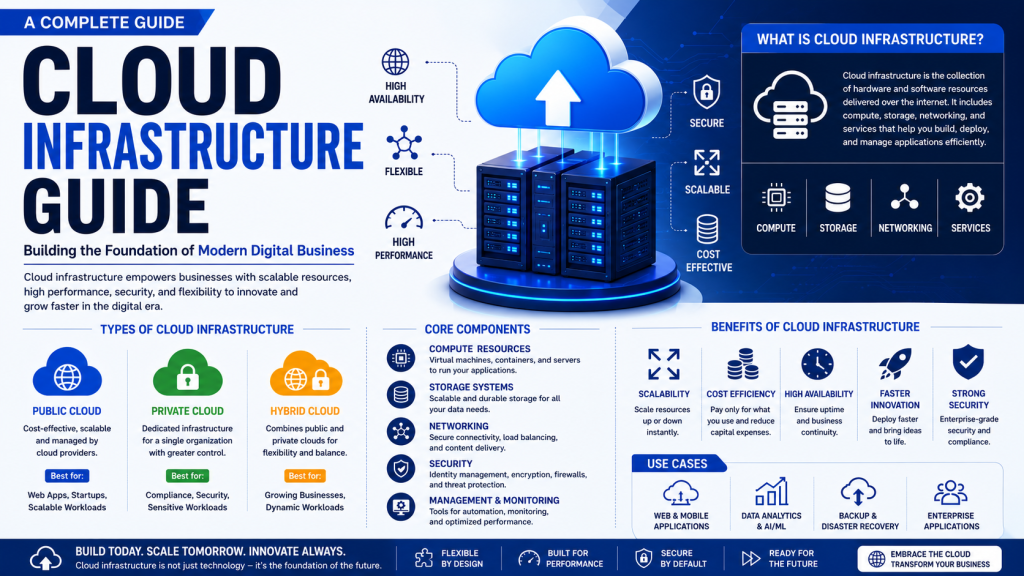
Cloud infrastructure powers modern businesses by providing scalable computing resources, secure storage, reliable networking, and flexible deployment options. It enables digital transformation, supports innovation, improves operational efficiency, and creates the technological foundation for future business growth.
In today’s digital-first economy, businesses rely heavily on technology to deliver services, manage operations, support customers, and drive innovation. As organizations continue adopting digital transformation strategies, cloud infrastructure has become one of the most important components of modern business technology.
Cloud infrastructure provides the computing resources, storage, networking, and services required to support applications, websites, data management, and enterprise operations. Instead of investing in expensive physical servers and data centers, organizations can access scalable computing resources through cloud service providers.
From startups and small businesses to multinational corporations, cloud infrastructure has transformed the way companies build, deploy, and manage technology solutions. It offers flexibility, scalability, security, and cost efficiency that traditional IT environments often struggle to provide.
As businesses continue moving toward digital operations, understanding cloud infrastructure has become essential for decision-makers, technology professionals, entrepreneurs, and students seeking to understand the future of enterprise technology.
What Is Cloud Infrastructure?
Cloud infrastructure refers to the collection of hardware and software components that enable cloud computing services.
These components typically include:
- Servers
- Storage systems
- Networking equipment
- Virtualization technologies
- Cloud management platforms
Cloud infrastructure allows businesses to access computing resources through the internet rather than relying solely on physical hardware located within their facilities.
Organizations can use cloud services on demand and scale resources according to business requirements.
This flexibility has made cloud infrastructure a critical part of modern IT strategies.
The Evolution of Cloud Computing
Traditional IT systems required organizations to purchase and maintain their own servers, storage devices, and networking equipment.
This approach often involved:
- High capital expenses
- Complex maintenance
- Limited scalability
- Resource inefficiencies
Cloud computing introduced a new model where businesses could access technology resources as services.
The cloud transformed IT from a capital-intensive investment into a flexible operational expense.
This shift accelerated digital innovation and improved access to advanced technology.
Core Components of Cloud Infrastructure
Cloud infrastructure consists of several key elements that work together to support digital operations.
Compute Resources
Compute resources provide the processing power required to run applications and workloads.
Examples include:
- Virtual machines
- Containers
- Application servers
These resources allow organizations to deploy and manage applications efficiently.
Storage Systems
Cloud storage enables organizations to store and access data securely.
Benefits include:
- Scalability
- Reliability
- Accessibility
Businesses can expand storage capacity as needed without purchasing additional hardware.
Networking
Networking infrastructure connects applications, services, and users.
Cloud networking supports:
- Data transfer
- Secure communication
- Application connectivity
Reliable networking is essential for cloud performance and user experiences.
Types of Cloud Infrastructure
Organizations can choose from several cloud deployment models.
Public Cloud
Public cloud services are provided by third-party cloud vendors and shared among multiple customers.
Benefits include:
- Lower costs
- Easy scalability
- Reduced maintenance
Public cloud environments are widely used by businesses of all sizes.
Private Cloud
Private cloud infrastructure is dedicated to a single organization.
Advantages include:
- Greater control
- Enhanced security
- Custom configurations
Private clouds are often used by organizations with specific compliance or security requirements.
Hybrid Cloud
Hybrid cloud combines public and private cloud environments.
This approach provides:
- Flexibility
- Scalability
- Improved workload management
Many enterprises adopt hybrid strategies to balance performance, security, and cost considerations.
Benefits of Cloud Infrastructure
Cloud infrastructure offers numerous advantages that support business growth and innovation.
Scalability
Organizations can increase or decrease resources based on demand.
This flexibility helps businesses manage changing workloads efficiently.
Cost Efficiency
Cloud services reduce the need for large upfront investments in hardware and data centers.
Businesses pay for resources as needed.
Improved Accessibility
Cloud-based systems allow employees to access applications and data from various locations.
This supports remote and hybrid work environments.
Faster Deployment
Cloud platforms enable rapid application deployment and development.
Organizations can launch new services more quickly than with traditional infrastructure.
Cloud Infrastructure and Business Growth
Modern businesses require technology systems that can support expansion and innovation.
Cloud infrastructure helps organizations:
- Launch new products faster
- Enter new markets
- Improve operational efficiency
- Enhance customer experiences
Technology flexibility allows businesses to adapt more effectively to changing market conditions.
Organizations that leverage cloud infrastructure often gain competitive advantages through increased agility.
Security in Cloud Infrastructure
Security remains a major priority for organizations adopting cloud technologies.
Cloud providers invest heavily in:
- Data encryption
- Identity management
- Threat detection
- Security monitoring
Businesses should also implement:
- Access controls
- Security policies
- Employee training
A shared responsibility model helps ensure that cloud environments remain secure and compliant.
Strong security practices are essential for protecting sensitive information and maintaining customer trust.
Disaster Recovery and Business Continuity
Business continuity is critical in today’s digital economy.
Cloud infrastructure supports continuity through:
- Data backups
- Geographic redundancy
- Automated recovery systems
Organizations can recover from disruptions more quickly than with traditional infrastructure models.
Reliable disaster recovery capabilities help minimize downtime and operational risks.
Cloud-based resilience has become a key business requirement.
Cloud Infrastructure and Digital Transformation
Digital transformation initiatives depend heavily on modern technology foundations.
Cloud infrastructure enables organizations to:
- Modernize applications
- Improve collaboration
- Support innovation
- Accelerate automation
Cloud services provide the flexibility needed to implement new technologies and respond to evolving business requirements.
As digital transformation continues expanding, cloud infrastructure remains a critical enabler of innovation.
Artificial Intelligence and Cloud Infrastructure
Artificial Intelligence increasingly relies on cloud-based resources.
Cloud platforms provide:
- High-performance computing
- Data storage
- Machine learning tools
- AI development environments
Organizations use cloud infrastructure to build, train, and deploy AI solutions efficiently.
The combination of cloud computing and AI continues driving technological innovation across industries.
Future Trends in Cloud Infrastructure
Several emerging trends are shaping the future of cloud technology.
These include:
- Multi-cloud strategies
- Edge computing
- Serverless architecture
- Artificial Intelligence integration
- Advanced automation
Organizations are increasingly seeking flexible and intelligent infrastructure solutions.
Future cloud environments will likely become more automated, secure, and efficient.
Innovation will continue expanding the capabilities of cloud platforms.
Choosing the Right Cloud Strategy
Successful cloud adoption requires careful planning.
Organizations should evaluate:
- Business objectives
- Security requirements
- Budget considerations
- Performance needs
A well-designed cloud strategy aligns technology investments with business goals.
Proper planning helps maximize value while minimizing risks.
Cloud adoption should be viewed as a long-term business transformation initiative rather than simply a technology upgrade.
Conclusion
Cloud infrastructure has become the foundation of modern digital business. By providing scalable computing resources, secure storage, advanced networking, and flexible deployment models, cloud technology enables organizations to innovate, grow, and compete more effectively.
As digital transformation accelerates, businesses increasingly rely on cloud infrastructure to support applications, improve operational efficiency, strengthen security, and deliver exceptional customer experiences.
Organizations that embrace cloud technologies position themselves for greater agility, innovation, and long-term success in an increasingly digital world.